
Clicks and impressions recorded across the 18-month report
48.1KThe practice went from 21 clicks on the day the programme started to 48,100 clicks and 3.23 million impressions across the eighteen-month report, and average position from 36.4 to 23.6. It was done almost entirely with blog content — 586 articles, 227 of them about liposuction alone — aimed at the two questions the profession will not answer in public: what it costs, and what recovery is really like.
- Clicks, 18-month report
- 21 → 48.1K
- Impressions, 18-month report
- 1K → 3.23M
- Clicks, last 6 months vs previous
- 9.54K → 35.5K
- Average position, 18 months
- 36.4 → 23.6
- Content items published
- 631
The problem
Aesthetic surgery is a your-money-or-your-life category where the buying decision runs on two questions the profession is least comfortable publishing: what it costs, and what recovery is actually like. Practices answer both with a consultation booking, so the queries go unanswered and the traffic goes to aggregators and medical tourism brokers.
The second problem was shape rather than substance. Cosmetic queries fragment enormously — "rhinoplasty cost in dubai", "nose job dubai cost", "nose surgery price in dubai", "rhinoplasty dubai price" are one intent wearing a dozen phrasings, and a site with one thin page per procedure picks up none of them.
What we did
Answer the money question on the page. Cost and price content was built per procedure with real ranges rather than "from" figures. In the thousand-query export, 172 of the ranking queries contain the word cost or price and they take 61% of the clicks in that sample — the clearest signal in the account of what this audience actually searches for.
Then depth rather than breadth. The content log records 631 published items across its twenty months, and it is deliberately lopsided: 227 of them are about liposuction alone, against 100 on breast augmentation and 80 on botox. Concentrating on one procedure until the site owns its whole question set — cost, candidacy, technique, recovery — beats spreading thin coverage across twenty procedures.
That depth is what catches the recovery queries nobody else writes. "How to sleep after liposuction" and "when can I sleep on my stomach after liposuction" together bring thirty clicks a month at positions four to six. They convert nothing directly. They are read by people two weeks from booking.
Two hundred and twenty-seven articles on liposuction alone. That is what it took to hold position three on "liposuction cost dubai" and the twelve ways people phrase it.
SEO strategy for an aesthetic surgery practice
The category rewards whoever is willing to answer the two questions the profession avoids in public: price, and what recovery actually feels like.
- 01Publish the priceCost queries take 61% of the clicks in this account’s query export. A practice that routes them to a contact form is declining the majority of its own search demand.
- 02Own every phrasing of one intent"Rhinoplasty cost in dubai", "nose job dubai cost", "nose surgery price in dubai" — a dozen phrasings, one question. One properly built page now holds positions five to nine across the lot.
- 03Go deep on one procedure before adding another227 items on liposuction against 21 on tummy tuck. The lopsidedness is the strategy: own a procedure completely, then move to the next one.
- 04Write the recovery questionsHow to sleep afterwards, when the swelling goes, when you can fly. Low volume, no commercial intent, read obsessively by people who have already decided — and almost nobody in the category publishes them.
- 05Keep it attributableA YMYL medical category discounts anything it cannot attribute. Procedure pages carry the operating surgeon and the practice’s credentials in the markup as well as the copy.
Straight out of the client’s Search Console
Three windows from the same property, screenshotted rather than retyped. The eighteen-month panel is the whole programme; the six- and three-month panels are the compares that sat inside it.
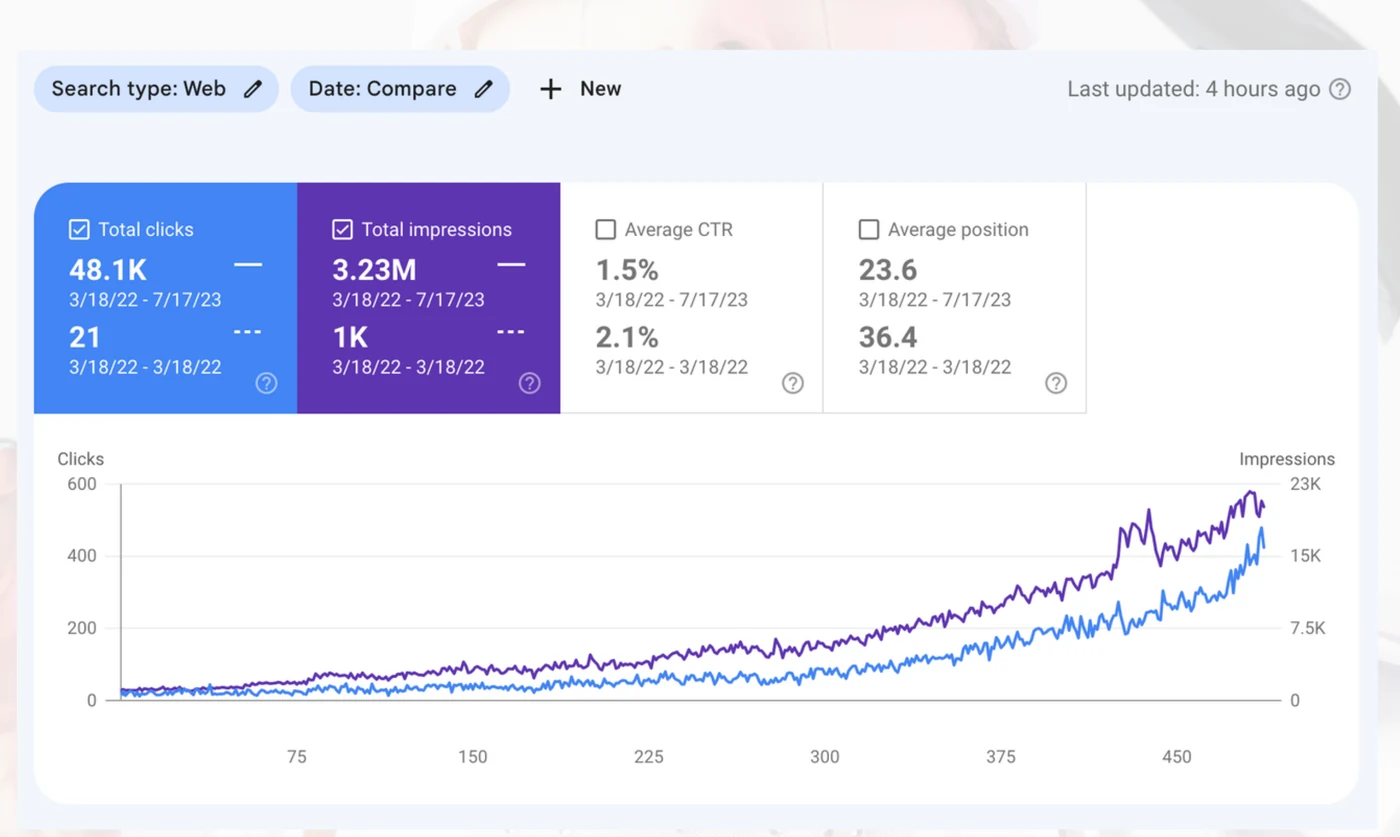
Eighteen months: 48.1K clicks and 3.23M impressions, against 21 clicks on the opening day. Average position 36.4 → 23.6.
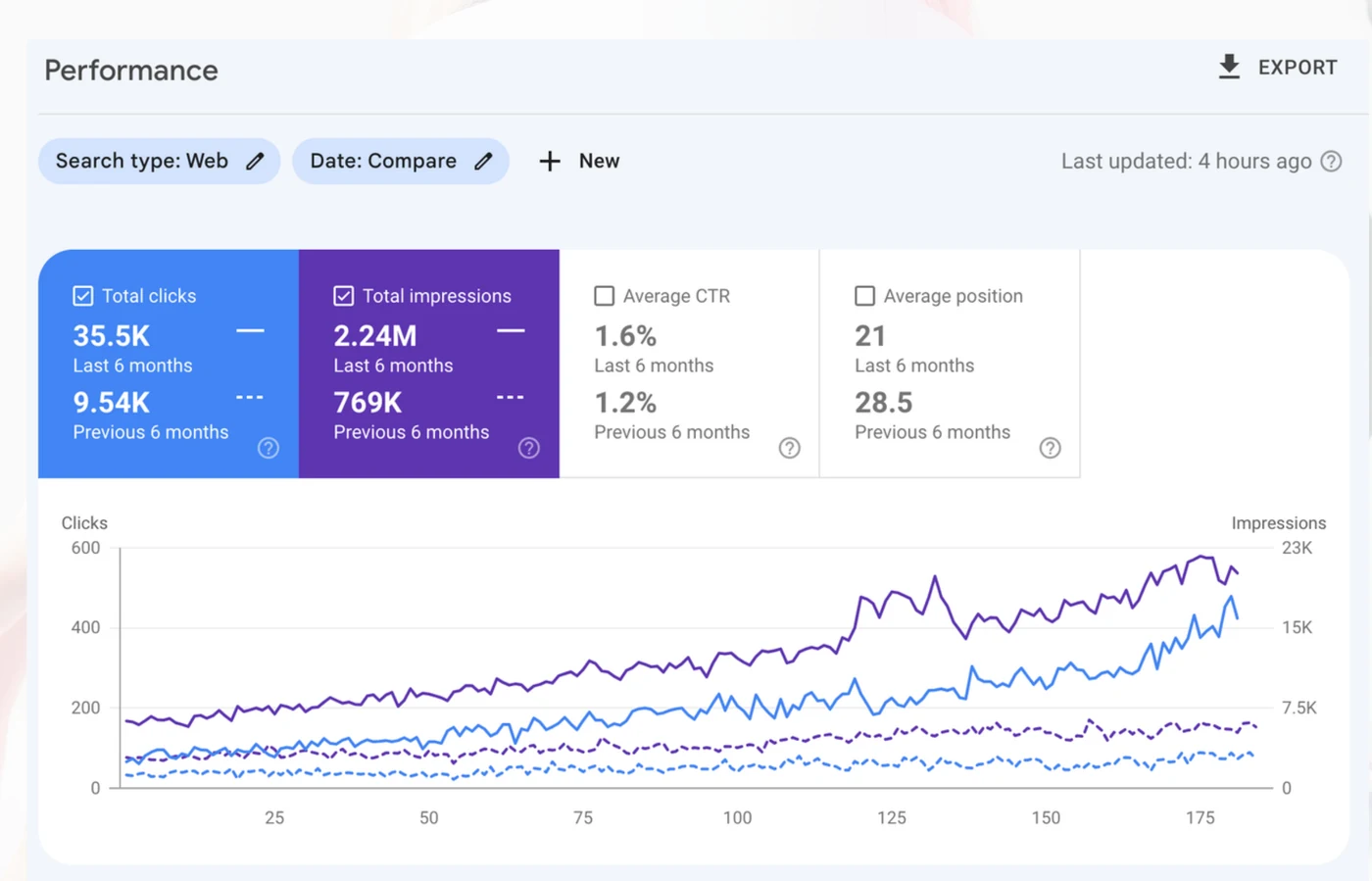
Six months against the previous six: clicks 9.54K → 35.5K, impressions 769K → 2.24M, average position 28.5 → 21.
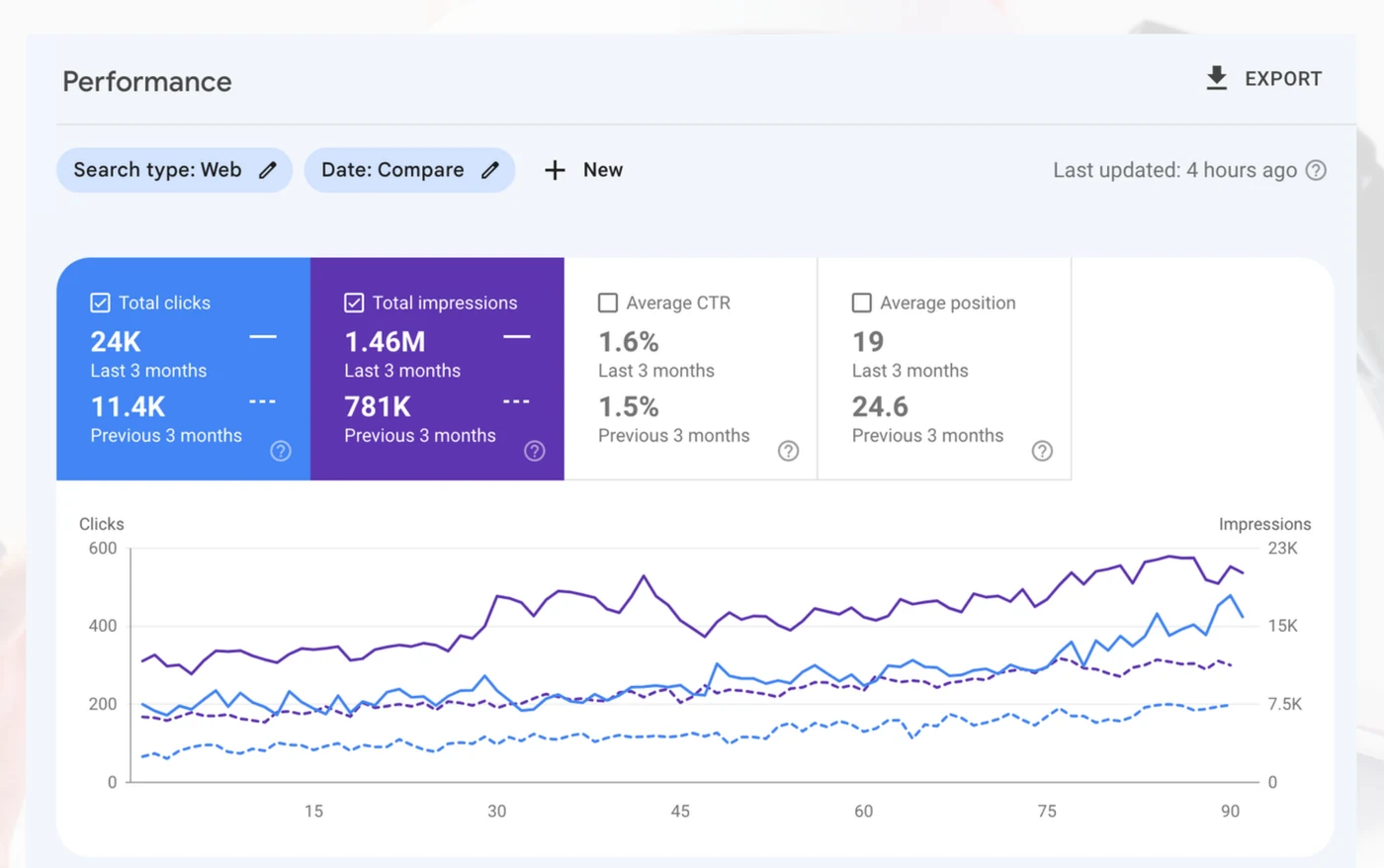
Three months against the previous three: clicks 11.4K → 24K, impressions 781K → 1.46M, average position 24.6 → 19.
Client’s own Google Search Console. Cropped to the performance panel, which carries no domain or account name.
The finding that set the content plan
Take the thousand-query export from the account and sort it by clicks. Three hundred and forty-nine of the 575 clicks in that sample arrive on a query containing "cost" or "price" — 61%, spread across 172 separate phrasings. Everything else combined, including brand searches, procedure names, surgeon comparisons and before-and-after queries, makes up the remaining 39%. In cosmetic surgery the money question is not one part of the funnel. It is the funnel.
Where the organic clicks actually come from
Search Console query export, top 1,000 queries. This is a sample of the account, not its total — the account-wide figures are in the screenshots above.
The queries doing the work
The top of the thousand-query export. Note how many are the same question rephrased.
Positions are the average reported by Search Console rather than a single-point rank.
One intent, twelve phrasings, one page
The rhinoplasty cost family. Every row is the same question and the same 880 monthly searches, and the same page answers all of them.
Twelve tracked keywords, one question, one page holding all of them inside the top ten.
The tracked set
The ranked set covers 90,460 monthly searches. In the most recent period 151 of these keywords improved and 77 declined.
Where the content actually went
- Liposuction
- 227
- Breast augmentation
- 100
- Botox
- 80
- Fillers
- 43
- Eyelid surgery
- 28
- Breast lift
- 27
- Tummy tuck
- 21
- Gynecomastia
- 12
The vein nobody else is writing
"How to sleep after liposuction" brings sixteen clicks a month at position 5.6. "When can I sleep on my stomach after liposuction" brings fourteen more. Neither will ever produce a booking on the visit. They are read by patients two weeks out from a decision, at the exact moment they are deciding whether this practice sounds like it knows what it is doing — and almost no clinic in the category publishes them, because they do not look like marketing.
What twenty months produced
A deliberately lopsided library. One procedure was taken to completion before the next was started.
- 631 items published between May 2023 and December 2024
- 586 articles, 21 service pages, 21 category pages and 2 gallery pages
- Twenty procedure clusters, with liposuction carrying 227 items on its own
- A cost page per procedure built on real ranges rather than "from" pricing
- Recovery and aftercare questions written per procedure, not as one generic guide
- Every phrasing of a cost query mapped to the single page that should answer it
- Items published
- 631Items published
- Procedure clusters
- 20Procedure clusters
- Items on one procedure
- 227Items on one procedure
How it unfolded
- May 2023
Programme starts
Procedure clusters mapped and the cost-query family identified as the commercial priority.
- 2023
Liposuction taken to depth
The first procedure worked until the site answered its whole question set — cost, candidacy, technique, recovery — rather than moving on early.
- 2024
Breast, face and injectables
Augmentation, lift, eyelid, botox and filler clusters built on the same pattern, with the cost page leading each.
- At the close
Where it sits
108 tracked keywords in the top ten, 38 in the top three, and the cost queries carrying 61% of organic clicks.
Where they ranked in December 2024
Real price ranges by treatment area and session, what the quote includes, and why per-area pricing differs between clinics…
Illustrative SERP layout.
Engagement note
This engagement has concluded and the client has not worked with us since. The figures here cover the reporting window named above and were correct at the close of our involvement; anything the site has done since sits outside the scope of our work. We are happy to walk through the full reporting history on request.
The verdict
The category avoids publishing prices and avoids describing recovery. Doing both, one procedure at a time until each was finished, is what put a single practice in front of the aggregators on the only question most patients actually search.
The part we don’t publish
We haven’t shown you the techniques. We’ll take you through them live.
A case study shows the outcome. The method behind it — the keyword architecture, the competitor gaps we exploited, what is working in your niche right now — is the part that is actually worth your time. Book a demo and we will open the live website and walk you through all of it.
No pitch deck, no commitment — a working session on your site and ours.
- The live site, walked throughScreen-shared end to end — what we changed, where, and why it moved.
- The full keyword setEvery term we ranked, with positions, volumes and intent — not a curated five.
- The competitor analysisWhat the incumbents were doing, and the gap we found to get past them.
- What is working in your nicheWhat your own competitors are being rewarded for right now, and which of it would transfer to your site.
Be the brand AI recommends.
AI optimisation (AIO) shows you what ChatGPT, Claude, Google AI, Gemini and Perplexity say when buyers ask about your market — then fixes it, on our platform or done for you by specialists.
- ChatGPT
- Claude
- Google AI
- Gemini
- Perplexity
Illustration: how often each AI names your brand in its answer